
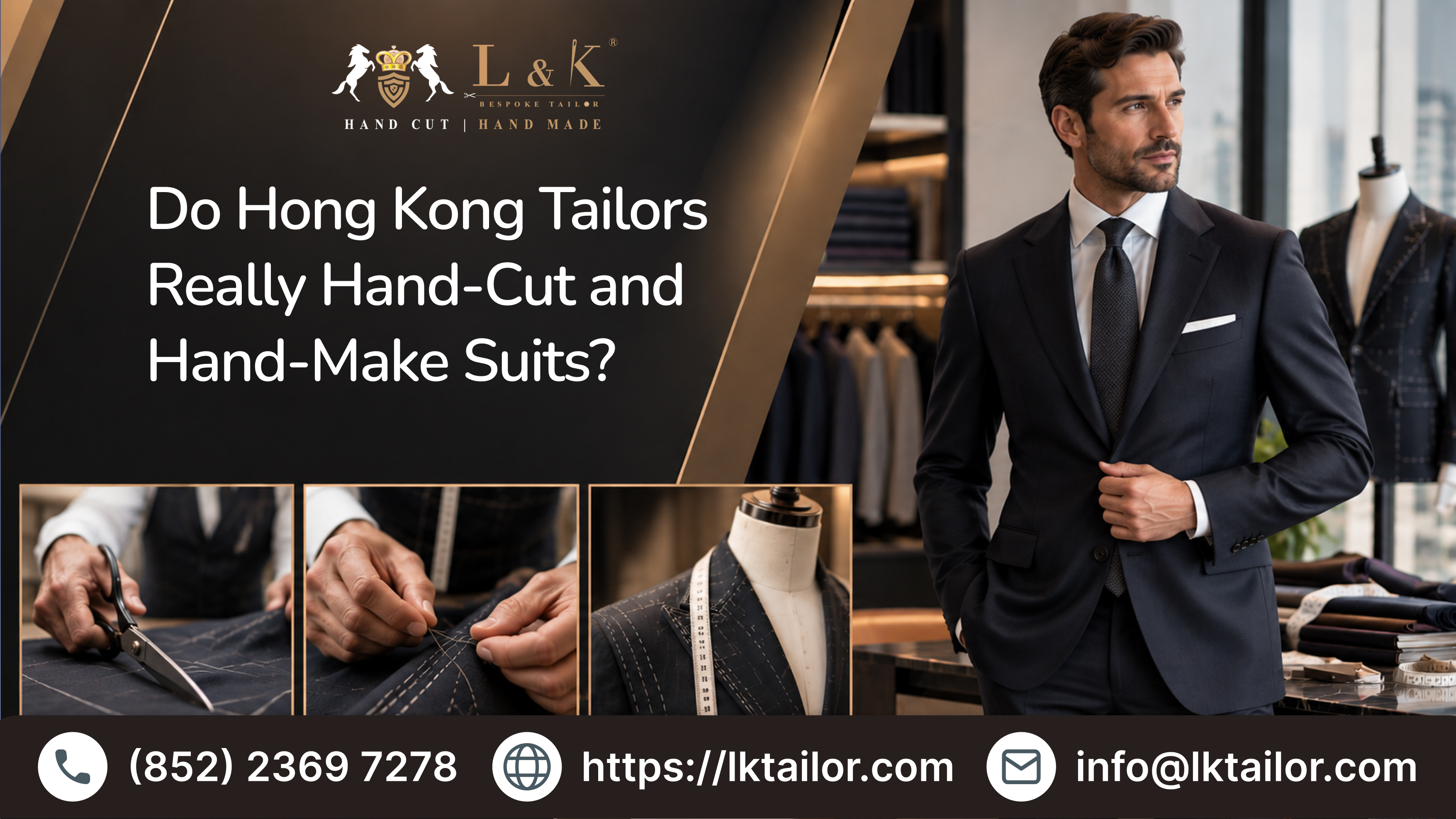
Yes, L & K Bespoke tailors Hong Kong do make hand cut and hand made suits, especially traditional bespoke tailors that focus on individual measurements, custom patterns, fittings, and hand-finishing. However, not every suit advertised as “hand-made” is made entirely by hand, so it is important to understand what the tailoring process actually involves.
If you are considering bespoke suits in Hong Kong, knowing how a suit is cut, fitted, constructed, and finished can help you choose a tailor with greater confidence.
What Does Hand-Cut and Hand-Made Mean in Tailoring?
The terms hand cut suits Hong Kong and hand made suits Hong Kong describe important parts of traditional tailoring, but they can mean different things depending on the tailor.
What Does Hand-Cutting a Suit Mean?
Hand-cutting means the fabric is individually cut according to the customer’s measurements and the pattern created for that garment. Instead of simply selecting a standard size, the tailor considers measurements such as chest, waist, shoulder width, sleeve length, and other proportions.
Traditional Hong Kong bespoke tailoring can also take posture and body shape into consideration. This allows the finished garment to be developed around the individual rather than a generic size. For someone looking for handcrafted suits in Hong Kong, the cutting stage is particularly important because even a high-quality fabric cannot produce the desired fit if the pattern and cutting are not carefully handled.
What Does Hand-Made Mean?
A hand made suit does not necessarily mean that every single part of the garment is sewn entirely by hand.
Depending on the tailor and construction method, hand craftsmanship may be involved in:
- Cutting the fabric
- Creating and adjusting the pattern
- Hand stitching
- Canvas construction
- Hand-finishing details
- Buttonholes
- Basting and fitting
- Final alterations
Therefore, when comparing hand cut and hand made suits by Hong Kong tailors, it is useful to ask exactly which stages are performed by hand.
How Is a Hand-Cut Bespoke Suit Made?
A traditional bespoke suit Hong Kong process generally involves several stages rather than simply taking measurements and producing a finished garment.
1. Consultation and Style Selection
The process starts with a discussion about the customer’s requirements.
The tailor may discuss:
- Suit style
- Jacket shape
- Lapel style
- Trouser style
- Fabric
- Buttons
- Pockets
- Intended use
- Personal preferences
This allows the garment to be designed around the customer’s needs.
2. Taking Individual Measurements
Accurate measurements are essential for bespoke suits Hong Kong customers.
A tailor may measure areas such as:
- Chest
- Waist
- Hips
- Shoulders
- Sleeve length
- Jacket length
- Trouser length
Posture and body proportions may also be considered when developing the pattern.
3. Creating the Pattern
One of the key differences between traditional bespoke tailoring and standard ready-to-wear clothing is the level of personalization involved in the pattern. The pattern is developed around the customer’s measurements and desired style.
4. Hand-Cutting the Fabric
The fabric is then carefully cut according to the pattern. This is where hand cut and hand made suits can differ significantly from mass-produced garments. Individual cutting gives the tailor greater control over how the fabric is shaped for the customer.
5. Initial Construction
The different sections of the jacket and trousers are brought together during construction. Depending on the garment and tailor, both hand and machine techniques may be used. The important factor is the craftsmanship, construction method, and quality control involved throughout the process.
6. Baste Fitting
A fitting allows the tailor to assess how the garment sits on the customer’s body before it is completely finished.
Adjustments can be made to areas such as:
- Shoulders
- Chest
- Waist
- Sleeves
- Jacket balance
- Trouser fit
7. Alterations and Final Fitting
After the fitting, required adjustments are completed before the final garment is finished. This process is one of the reasons customers choose traditional bespoke tailoring rather than simply buying an off-the-rack suit.
How Can You Tell if a Suit Is Really Hand-Cut?
If you are comparing hand cut suits Hong Kong tailors, don’t rely only on the words “hand-made” or “hand-cut.”
Instead, ask the tailor about the actual process.
Ask About the Pattern
Does the tailor create an individual pattern based on your measurements?
Ask About the Cutting
Who cuts the fabric, and is the fabric individually cut for your garment?
Ask About Fittings
Does the process include a fitting before the final garment is completed?
Ask About Construction
Ask what construction method is used and which parts involve hand craftsmanship.
Ask About Alterations
A genuine bespoke process should allow the garment to be adjusted based on how it fits during the fitting stages.
These questions can help distinguish genuine craftsmanship from simple marketing terminology.
What Is the Difference Between Hand-Cut and Factory-Made Suits?
Understanding the difference can help customers decide what type of tailoring is right for them.
| Feature | Hand-Cut Bespoke Suit | Factory-Made Suit |
| Measurements | Individual measurements | Standardized sizes |
| Pattern | Customer-specific | Standard pattern |
| Cutting | Individual cutting | Production cutting |
| Fittings | Bespoke fitting process | Usually limited alterations |
| Customization | High | More limited |
| Style Choices | Highly customizable | Predetermined options |
| Construction | Tailoring-focused | Production-focused |
This does not mean that every factory-made suit is poor quality or that every hand-cut suit is automatically superior. The quality depends on the tailor, materials, construction, fitting, and finishing.
Why Does Hand-Cutting Matter in Bespoke Tailoring?
For customers interested in custom made suits Hong Kong, individual cutting can be an important part of the overall tailoring process.
Personalized Fit
A custom pattern can account for individual measurements and proportions.
Individual Style
Customers can select details such as lapels, pockets, buttons, jacket length, and trouser style.
Greater Customization
Unlike standard sizing, bespoke tailoring gives the customer more control over the final garment.
Attention to Craftsmanship
Traditional tailoring places greater emphasis on the individual construction and finishing of the garment.
This is why people searching for a bespoke tailor Hong Kong often look beyond fabric selection and ask about the actual tailoring process.
Are Hand-Cut Suits Better Than Machine-Made Suits?
There is no simple answer. A hand cut and hand made suit can provide a highly personalized tailoring experience, but “hand-made” alone does not determine the overall quality of a suit.
Other factors include:
- Tailor experience
- Pattern quality
- Fabric quality
- Construction
- Fitting
- Alterations
- Finishing
- Customer requirements
For customers comparing Hong Kong bespoke tailoring, it is better to evaluate the complete process rather than focusing on one feature.
Why Is Hong Kong Known for Bespoke Tailoring?
Hong Kong has a long association with custom tailoring and is known internationally for its tailoring services. Customers visiting Hong Kong may look for a bespoke tailor Hong Kong service because they want individual measurements, fabric selection, customized styling, and a more personal fitting experience.
The city also attracts international customers who may visit for a fitting or arrange tailoring services around their travel schedule. For someone searching specifically for hand made suits in Hong Kong, the important consideration is not simply where the suit is made, but how the tailor approaches measurement, cutting, fitting, construction, and finishing.
Do L & K Tailor Hand-Cut and Hand-Make Suits?
L & K Custom Tailors in Hong Kong focuses on traditional bespoke craftsmanship and offers individually tailored garments for customers looking for personalized fit and styling. If you are interested in bespoke suits in Hong Kong, you can explore the bespoke suits service to learn more about the tailoring process, available styles, and customization options.
Customers interested in other tailored garments can also explore bespoke shirts for custom shirt options and wool suits for tailored wool garments. To learn more about the company and its approach to tailoring, visit L & K Tailor and explore the brand’s tailoring services.
What Should You Ask a Hong Kong Tailor Before Ordering a Suit?
Before ordering custom made suits Hong Kong, consider asking these questions:
Is the Suit Individually Patterned?
Ask whether your measurements are used to create or adjust an individual pattern.
Who Cuts the Fabric?
Understanding who performs the cutting can help you understand the tailoring process.
How Many Fittings Are Included?
Ask when fittings take place and whether alterations are made between fittings.
What Construction Method Is Used?
Ask about the construction of the jacket and the role of hand craftsmanship.
Can I Choose the Fabric and Details?
A bespoke experience should generally provide a high degree of customization.
What Happens After the First Fitting?
Ask how alterations are handled before the final garment is completed.
Are Hand-Cut Suits Worth It?
For customers who value personalized fit, craftsmanship, and customization, hand cut and hand made suits can be worth considering. The biggest advantage is the overall bespoke process rather than one individual technique. Measurements, pattern development, fabric selection, fitting, alterations, and finishing all contribute to the final result.
If you are comparing handcrafted suits Hong Kong options, look at the complete process and ask questions before making your decision.
Frequently Asked Questions
Are Hong Kong suits really hand-made?
Some Hong Kong bespoke tailors offer hand-cut and hand-made garments. However, the exact amount of hand craftsmanship varies, so customers should ask about the specific construction process.
What is a hand-cut suit?
A hand-cut suit is individually cut according to the customer’s measurements and pattern rather than being cut solely according to a standardized garment size.
What is the difference between bespoke and ready-to-wear suits?
Ready-to-wear suits are produced using standardized sizes, while bespoke tailoring focuses on an individual’s measurements, pattern, fitting, and customization.
Are hand-cut suits more expensive?
The price can vary depending on the tailor, fabric, construction, customization, and amount of craftsmanship involved.
How many fittings does a bespoke suit need?
The number of fittings varies depending on the tailor, garment, customer’s body shape, and required alterations. The fitting process is an important part of creating a personalized garment.
What should I look for in a Hong Kong bespoke tailor?
Look at the tailor’s experience, measurement process, pattern development, cutting method, fitting process, construction, fabric selection, and finishing.
Final Thoughts
So, do Hong Kong tailors really hand-cut and hand-make suits? Yes, traditional bespoke tailors can use hand cutting and significant hand craftsmanship as part of the suit-making process. But customers should look beyond marketing terms and understand how the garment is actually measured, patterned, cut, fitted, constructed, and finished.
For customers searching for hand cut suits Hong Kong, hand made suits Hong Kong, or bespoke suits Hong Kong, understanding the complete process is the best way to evaluate a tailor. If you are looking for personalized tailoring in Hong Kong, explore L & K Tailor and its bespoke tailoring options.